McLaughlin
Aerospace
Earth rise 1968 Apollo 8 by William Anders
About Us
We currently have a small reusable hypersonic rocketplane ready to proceed to demonstration. The small vehicle provides risk reduction for larger multirole rocketplanes with transcontinental and global point to point delivery and many other commercial and national security missions. The small vehicle however is an excellent hypersonic target, hypersonic testbed and can provide several minutes of microgravity. Other projects include a new look at Artificial Gravity Space Stations and Thermal Rocket Cislunar Applications. We have responded to the Office of Science and Technology Policy (OSTP) requests for information on the Sustainability of Microgravity R&D. Summaries are posted at the bottom of this website. Full responses are available upon request.
McLaughlin Aerospace LLC was founded in 2021 following Martin McLaughlin's retirement from Northrop Grumman after 39 years of aerospace system development including aircraft (F/A-18, F-20, B-2, YF-23, TSSAM, X-35, F-35) and space transportations systems (CEV, Altair, Ares V, MLAS, XS-1 and HLS). McLaughlin Aerospace has a team of experts from industry, government and academia.
Contact Us
martin@mclaerospace.com
(817) 239-0198
Reusable Hypersonic Rocketplane System
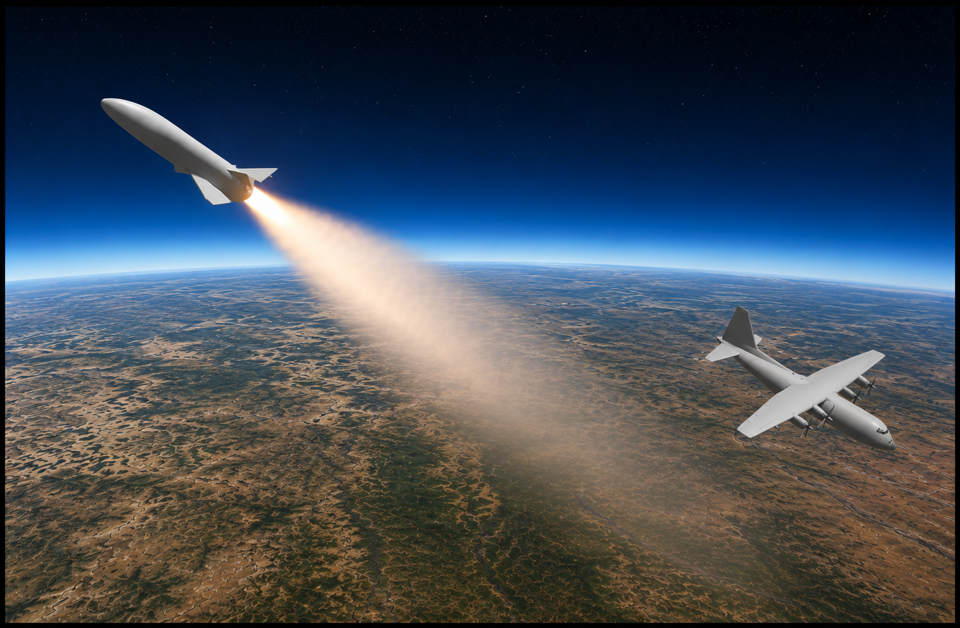
Reusable hypersonic rocketplane and commercial C-130 support plane
Many air-launched rocketplanes have been proposed over the last 50-60 years due to their potential operability benefits, but so far none have been both a technical and financial success. Dedicated motherships add large fixed costs and captive carriage adds human ratings and safe separation complexity. Previous tests of towed concepts were promising but the maximum takeoff weight (MTOW) drove heavy landing gear or dropped takeoff trolleys. Our rocketplane is towed to release altitude by a missionized C-130 aircraft that carries the oxidizer on board and transfers it to the rocketplane at altitude. That lowers the MTOW by 58% and enables light landing gear and a small vehicle. Oxidizer transfer is the enabler for single stage fully reusable rocketplanes. After the tow mission the C-130 returns to cargo operations reducing fixed costs. Under tow the rocketplane is not a hazard to the C-130 flight crew. We have a quad-redundant towline separation system that ensures the C-130 can release the rocketplane. Safe separation is also much easier compared to any captive carriage concept.
Air-launch Potential Benefits
• Not tied to a fixed littoral launch site vulnerable to weather, traffic conflicts and hostile actions
• Can operate worldwide
• Can fly to the release window in the sky on demand rather than wait on a pad for a limited duration launch window
• Enables covert and unwarned missions
• Multirole national security and commercial missions
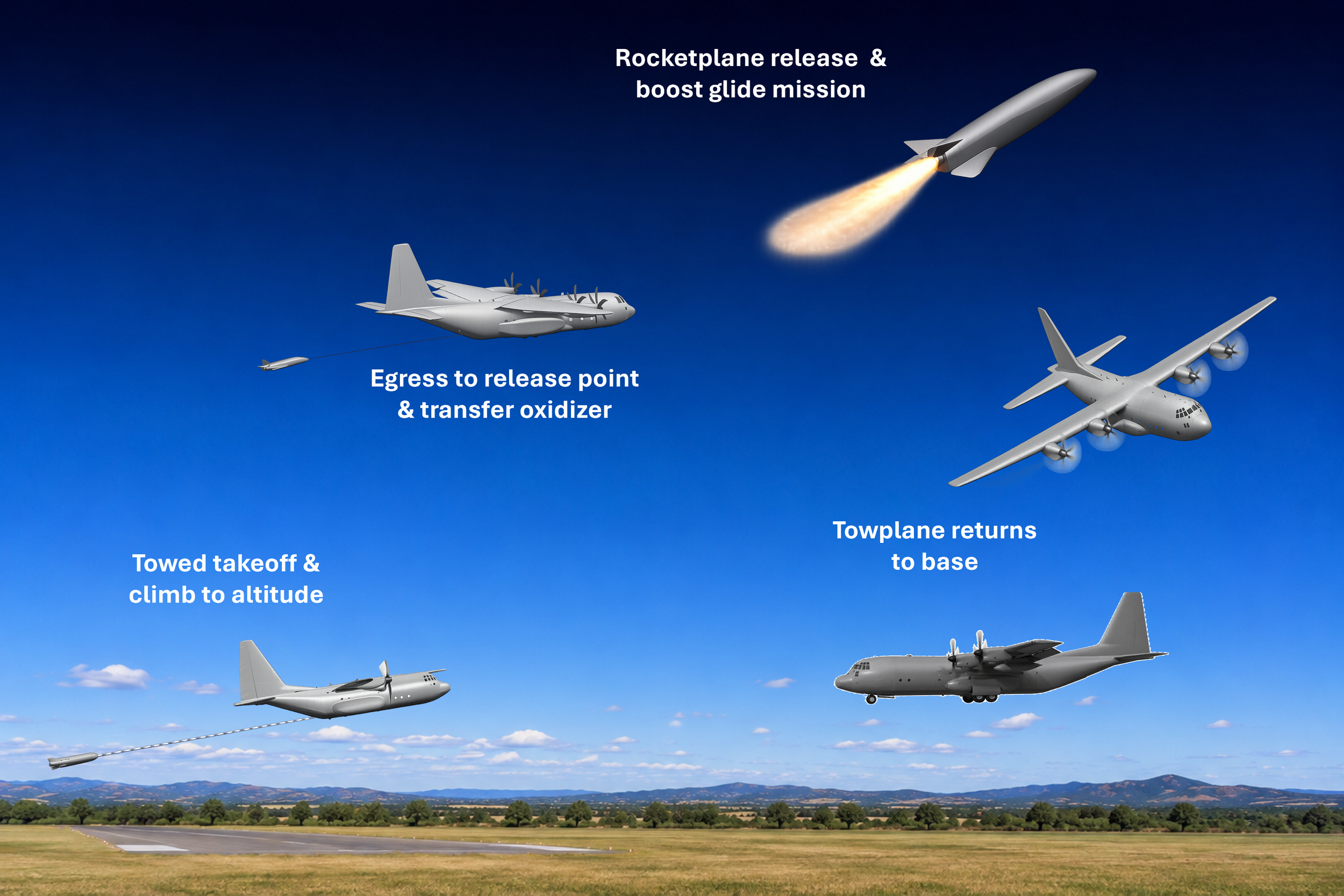
Concept of Operations
Since the oxidizer is onboard the towplane and the fuel is on the rocketplane separated by a long towline, we do not have an explosive mixture on the runway and can operate from airfields worldwide. The rocket engine is not started until at altitude and down range so we are good neighbors without rocket engine noise and blast-overpressure clearance restrictions. Since the system is all reusable without any dropped elements the system can operate from inland airfields and once mature at any azimuth.
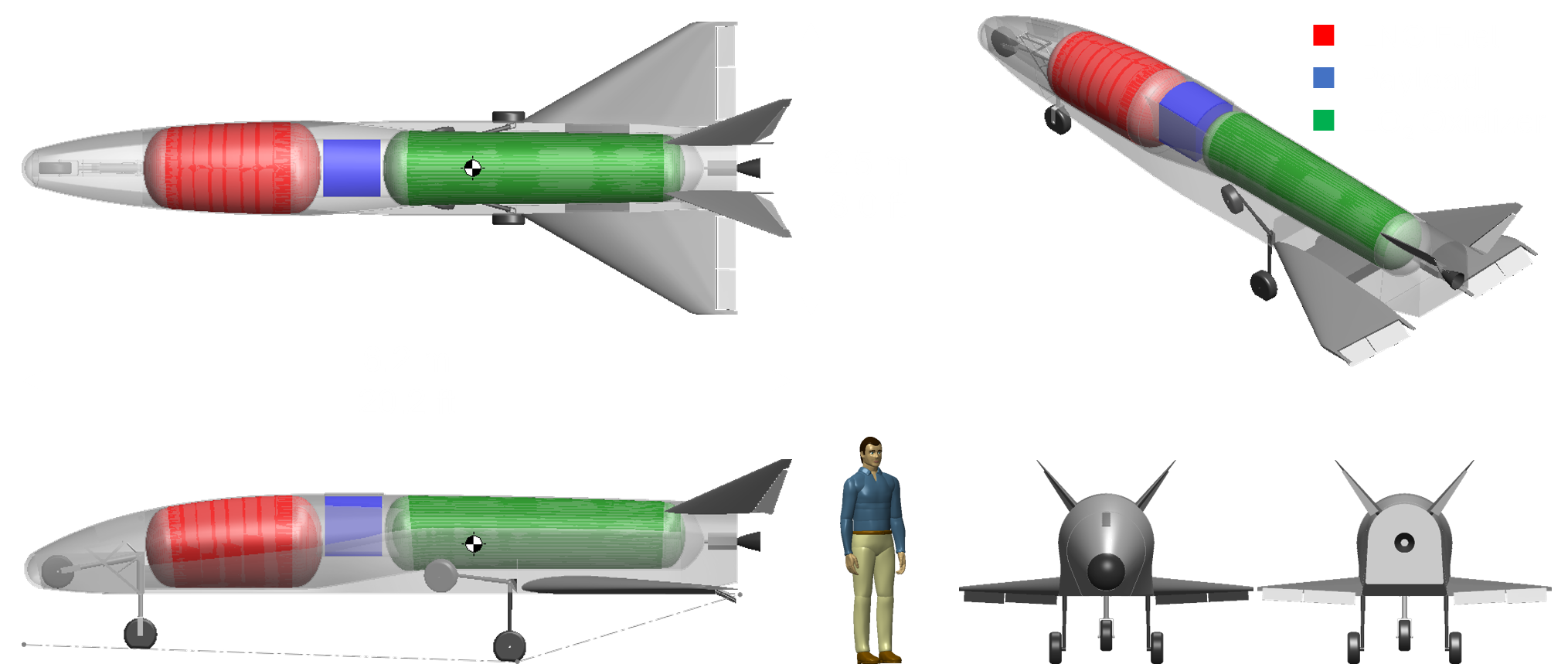
Current small rocketplane configuration
Our small rocketplane configuration is a liquid natural gas (LNG) liquid oxygen (LO2) propellant vehicle using the New Frontier Aerospace Mjölnir rocket engine. The airframe is a highly unitized advanced composite structure with coherent and distributed load paths. The nose is blunted and the bottom is flat for aeroheating management. The wing is a unitized low wing carry through that slides under the offset LO2 tank.
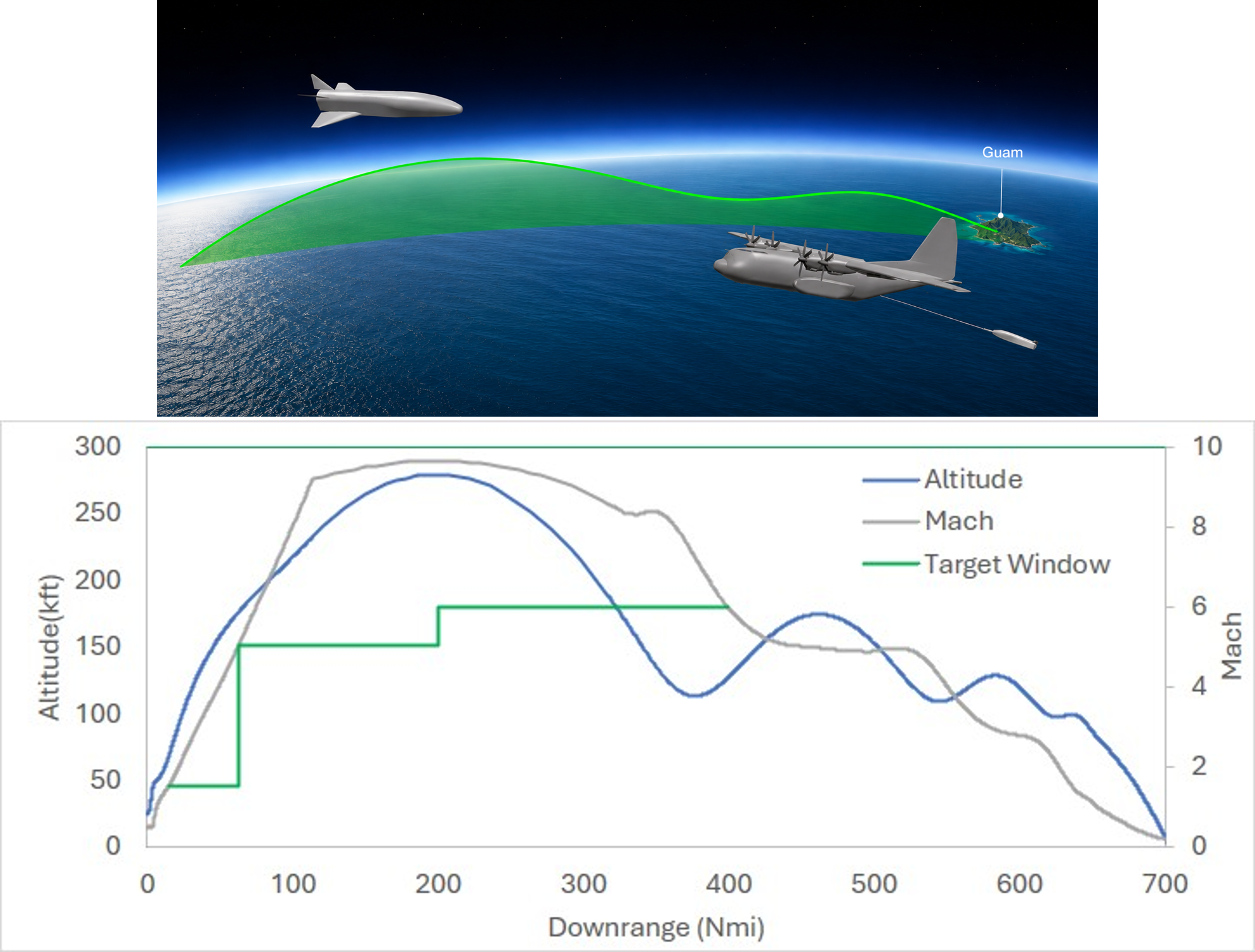
Reusable hypersonic rocketplane challenging Guam integrated air and missile defenses
Above is an example reusable hypersonic target campaign at Guam. We can fit two of the small rockeplanes inside the C-130 and deploy to Guam. The rocketplanes are unloaded and towed one at a time by the C-130 about 700 nautical miles west of Guam where the rocketplane is released and boost glides back toward Guam in a simulated hypersonic attack. Engagement windows exercise the integrated air defenses during boost, climb to apogee and a high speed target engagement. At a safe distance from Guam the vehicle diverts south of the island, burns off energy in a wide turn and lands from the east at Andersen Air Force Base. One or two missions can be run per day at various azimuths and attack profiles. If a kinetic kill mission is desired we would move to a test range like the Ronald Reagan Space and Missile Test Range in the Marshall Islands.
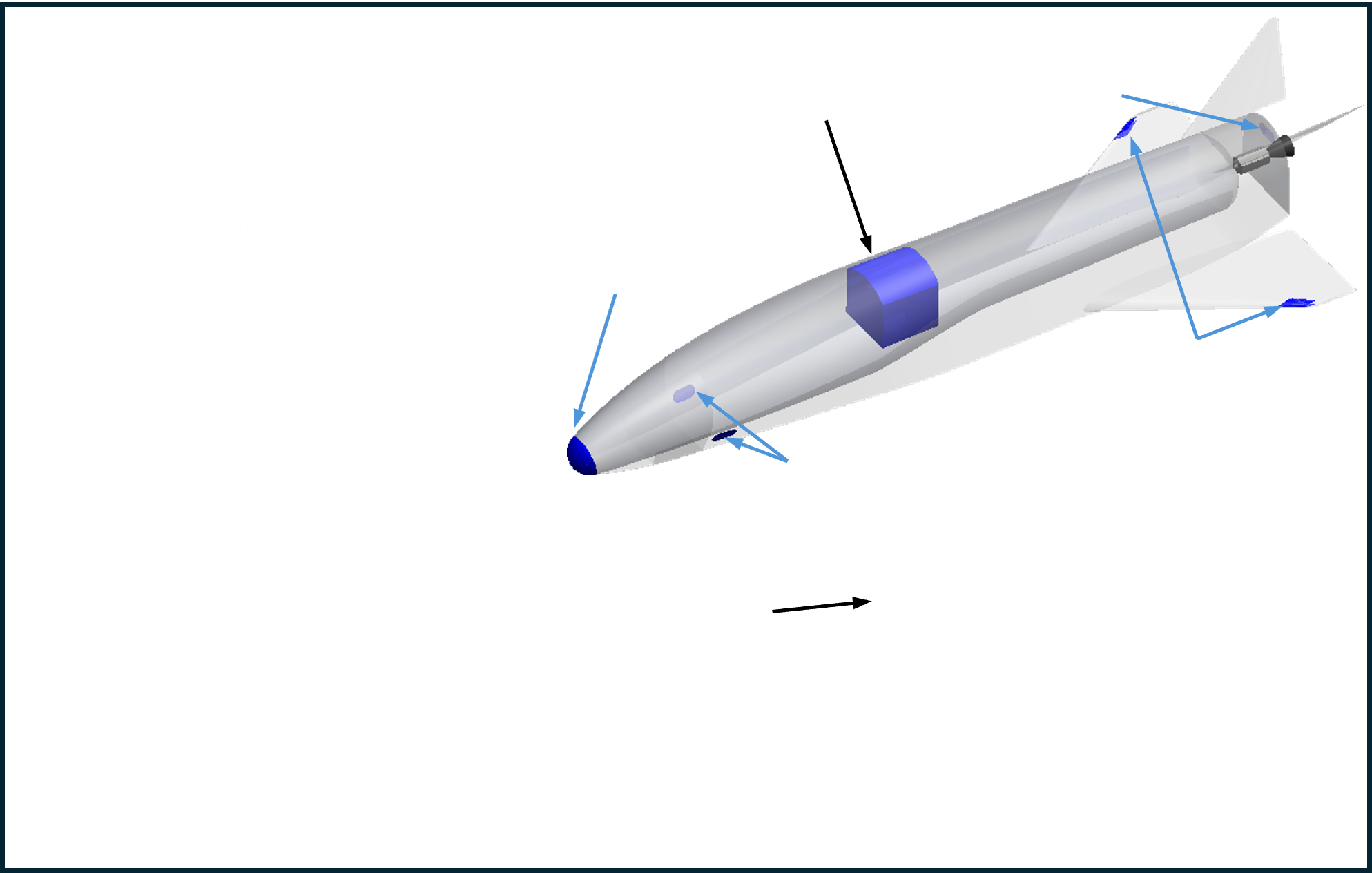
Our reusable hypersonic rocketplane supports flight research, sensors, materials, communications, thermal protection systems, guidance algorithms, and payload development. There are built in locations on the rocketplane for test panels, leading edge test elements and a replaceable nose component. The recommended progression is to test materials using the panels and run through a set four flight tests progressing from a simple checkout flight through a severe hypersonic exposure flight. Once materials are verified, then progress to leading edge elements. Then an advanced nose, perhaps with a subsystem behind, can be run through the flight sequence. Data can be stored on board for upload upon landing eliminating the cost and complexity of extensive telemetry.
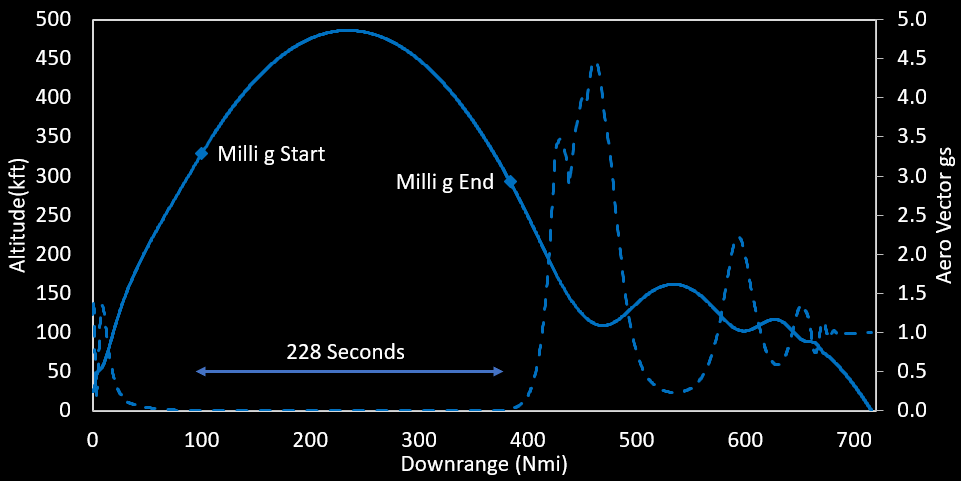
A more ballistic trajectory provides 228 seconds of continuous milli g
With a more ballistic trajectory our reusable hypersonic rocketplane provides over 3.5 minutes of continuous milli g. This will enable much lower cost microgravity development and checkout of microgravity systems before committing to an orbital system.
Artificial Gravity Space Station
Spinning space stations for artificial gravity have been suggested since the 1920s by Konstantin Tsiolkovsky, Wernher Von Braun, Arthur C. Clarke, Gerry O'Neil and others . A spinning space station was featured in the 1968 film 2001 A Space Odyssey. All of those were very large and complex and would likely not be practicable to launch from Earth. They will likely have to wait until the availability of in-space manufacturing with lunar or asteroid construction materials.
Our concept study is developing a simple dumbbell configuration that can be launched in just three Falcon 9 launches. Our concept includes isolation bearings for non-spinning laboratories at the station centerline. This enables precision microgravity scientific and commercial research. Researchers can spend very long durations on station without loss of condition for return to Earth.
The station can be spun at different rates for Mars or Lunar gravity. The habitats and laboratories can be reconfigured for the specific mission needs.
We are using AGI STK software to evaluate low Earth orbits, high Earth orbits and cislunar locations such as the Earth Moon LaGrange points. The user experience is also being evaluated by adding various spin rates, pointing angles and perspectives in the various compartments in the station.

Screen capture of sunrise from the Space Station configuration SS-02a in a 116 degree inclination orbit, at 3,385 kilometer altitude with the spin axis pointing at the center of the Earth. (ANSYS/AGI STK simulation)
This is a video capture of a physics based simulation using ANSYS/AGI STK simulation software. The video shows the Earth moving along with the space station orbit and the spin of the station to create artificial gravity as if on Earth. The point of view is as if you were in the right hand habitat. For this case the station is in a polar orbit at 500 kilometers altitude and the station is spinning with the spin axis pointed at the center of the Earth at 4.7 rpm. You can see Cape Canaveral and Central Florida as the station's orbit progresses southward. The ground is spinning from the point of view of a person in the right hand habitat. Please submit your questions, comments or suggestions.

This is the same orbit as the previous video except looking up toward space.
We are collaborating with Dr. Tammy Chang, Professor of Surgery at the University of California at San Francisco where her laboratory conducts liver tissue engineering in simulated microgravity. She has shown that liver tissues grow faster, larger and with more function in microgravity. She now has an experiment ready to fly on the International Space Station. See her website, The Chang Laboratory for Liver Tissue Engineering, at https://livertissueengineering.ucsf.edu
Tammy points out that having both microgravity and artificial gravity compartments on a space station provides the required microgravity laboratory and artificial gravity compartments for on board researchers health and comfort and also lab space for control experiments and standard analysis instruments that do not work in microgravity. This enables near real time evaluation rather than waiting weeks and months for samples returned to Earth with time delay and reentry environment potential impact on results that confuse and delay progress.
Thermal Rocket Cislunar and Solar System Applications
Thermal Rocket Propulsion
Thermal rocket propulsion uses beamed energy heat from a remote power plant to heat LH2 propellant and accelerate it through a normal convergent/divergent rocket nozzle. If the LH2 is heated to 2,000K it gasifies and with a traditional contraction and expansion ratio nozzle produces over 750 seconds of Isp. If the LH2 is heated to 3,000K it disassociates to atomic hydrogen and produces over 1,000 seconds of Isp. In both cases the thrust to weight is similar to chemical rocket propulsion and more than enough for fast transits and Earth, Moon and Mars launch and landing. Of course, beamed energy is much simpler in space without an atmosphere. Thermal rocket engines can be omnivores and use available in-situ propellants with some Isp reduction
Thermal Rocket Cislunar and Solar System Applications
•Fast transit cislunar space defense
•Fast transit human missions to the Moon and throughout cislunar space
•Lunar landers
•Lunar Prospector Hoppers
•Fast transit missions to Mars with greatly reduced radiation exposure
•Mars landers
•Beamed thermal and electric energy to point of need
OSTP Sustainability of Microgravity R&D Request for Information Response Summary
Question 1:
“What should be the United States' vision for the future of microgravity research?”
Short answer to question 1:
We believe the United States’ vision for the future of microgravity research should be to maintain the continuity of current research in low Earth orbit (LEO) while expanding research, exploration and commercial development utilizing all LEO and cislunar space resources for the betterment and expanded opportunities for all on Earth.
Detailed answer to question 1:
In order to meet this vision, future research platforms, need to be expanded to include longer duration experiments with pristine microgravity not interrupted or jolted by visiting spacecraft docking or system vibration and noise. Samples from the microgravity experiments need to be evaluated near real time and not have to wait weeks or months for down mass transportation to a terrestrial laboratory. Living arrangements need to accommodate expert researchers and technicians and must provide for their health and comfort for both short and long durations. On demand communication to experts and loved ones on Earth must be available for crew wellbeing but also to transfer work to Earth facilities. Sustainable logistics from and back to Earth and eventually from cislunar resources need to be reliable and affordable. Human-machine interfaces need to be built in to transfer work from expert researchers to automated production with mostly maintenance and upgrade technicians on board when required.
Question 2:
“What should be the long-term microgravity research goals for U.S. presence in LEO?”
Short answer to question 2:
Certainly, LEO microgravity research will be required for the foreseeable future due to the close proximity, lower transportation costs and manageable radiation hazards inside the Van Allen belts. Our long-term goals in LEO should be the preparation and support for the broader cislunar research, exploration and commercial development vision discussed previously. In addition, the U.S. should support the rule of law, traffic control, debris mitigation, communication, transportation, power and logistics for LEO commercial development
Microgravity and Artificial Gravity Human Health and Wellbeing:
A critical goal that can and should be accomplished in LEO is a clear understanding of human health and wellbeing in microgravity and partial to full Earth artificial gravity We have good data from the MIR space station and especially from the ISS on the effects of microgravity but almost no knowledge of the effects of partial gravity or the human tolerance for gravity gradients and rotation rates in spinning artificial gravity platforms. This knowledge is required for the design of future cislunar platforms, lunar bases, Mars missions, etc. The current estimate for the maximum rotation rate humans can tolerate due to the Coriolis effect and gravity gradient is 4 revolutions per minute (rpm). To achieve full Earth gravity at 4-rpm requires a spin radius of 55-meters. Of course, the 4-rpm limit is an estimate and could vary widely for a diverse human population and crews may be able to be conditioned for higher spin rates. The gravity gradient for a six-foot-tall standing person rotating at 4-rpm in a 55-meter spin radius platform is 9.81 to 9.48-m/s2 or a 3.3% change. We need to understand these effects much better and can do it in an experimental spinning space station before committing to the design of large LEO, cislunar or exploration systems. A full circular hoop configuration makes sense for the future, especially if it is made in space using lunar and perhaps near-Earth asteroid materials, but the gravity level, spin rate and spin diameter effects need to be well understood before proceeding with such a huge investment. Pristine microgravity compartments with low impact docking ports and low vibration systems are required for microgravity research and made in microgravity production. Artificial gravity habitats provide crew health and comfort as well as workstations to manage the microgravity activities, control experiments and analytical laboratory instruments that cannot function in microgravity. This allows researchers to tend their microgravity experiments and retrieve samples for immediate comparison to artificial gravity control samples using standard terrestrial laboratory instruments such as gene sequencers, mass spectrometers, etc.
Made in Microgravity Human Organ Tissues
LEO is perhaps the best location for research, development and then production of human organ tissues for eventual use in human transplants. Early experiments indicate that growing human organ tissues in microgravity enables the growth of isotropic three-dimensional (3D) tissue structure that lay flat when attempted in Earth gravity. This improves diffusion, fluid flow and growth rate. The microgravity organoid function continues to improve over time possibly due to better fluid flow through the more 3D structure. Tissues can be grown from disassociated organ tissues or human skin derived stem cells. Since the cells have the genetic instructions in their DNA, it is possible that the microgravity grown isotropic tissues will differentiate and form a vascular system and sinew sufficient for transplant. Liver, retinas and other organs have potential and could make significant impact on human health on Earth as transplant tissues or treatments. Liver tissues are particularly interesting due to the dire need and the natural ability of livers to regenerate to full size with only a one third adult liver mass transplant tissue. LEO is a great location due to the lower up and down mass transportation costs, low latency for automated system telemetry and manageable space radiation due to the Van Allen belts. With some Government stimulus, made in LEO human organ tissues could transition nicely to commercial operations.
Question 3:
“What are the top critical research, development, or operational needs required to ensure a smooth transition between the International Space Station and future commercial LEO microgravity platforms and realize the ideal future of microgravity research?”
Answer to question 3:
Time is running out to develop and deploy the next LEO research platforms before the ISS is retired. Perhaps a number of simple, optionally inhabited platforms make sense. The B-21 bomber is being designed to be optionally piloted and serves as a model for an optionally inhabited LEO research platform. A gap in LEO R&D waiting for an exquisite new platform would be terrible. Do not let perfect be the enemy of on time and good enough.
Question 4”
“What would be the most effective role of the U.S. government to ensure sustained LEO microgravity R&D following the retirement of the ISS?”
Short answer to question 4:
The U.S. government most effective roles to ensure sustained LEO microgravity R&D are:
Enforce the rule of law with international partners
Manage orbital traffic control
Establish and enforce debris mitigation treaties and methods
Manage and ensure available and open communication
Establish and enforce cyber security treaties and methods
Improve safety and reliability through expert objective accident prevention and investigations
In addition, the US government should promote commercial research and made in LEO economy via:
Promote affordable space transportation as an anchor customer
Promote electric and thermal power and other logistics as an initial provider and later as an anchor customer
Stimulate promising LEO commercial research and development through seedlings and other grants and by providing an anchor customer
Question 5:
“Should the U.S. government continue to sponsor a national lab in LEO after ISS transition? If so, what would be the best model(s) for a LEO national lab?”
Answer to question 5:
Possibly. A cislunar national lab and lunar national labs makes sense. LEO R&D can likely be transferred to commercial outfits. A possible exception is the Microgravity with artificial gravity research platform.
Partners and Supporters

Ansys/AGI System Tool Kit (STK) simulation software and support
SpaceWorks QuickShot for trajectory optimization
Griffon Aerospace autonomous air vehicle design, build and operations
New Frontiers Aerospace Mjölnir rocket engine
Princeton Cryo commercial and aerospace cryogenic systems
International Air Response commercial C-130 operations
NASA Glenn Chemical Equilibrium and Applications (CEA) software and support
SolidWorks/MLC-CAD Computer Aided Design (CAD) software and support
Saint Gobain pressure activated seals and design support
The Chang Laboratory for Liver Tissue Engineering at the University of California San Francisco
Get in Touch
We are looking for interns or retirees who would like to participate.